Brand Equity
Mr Nanoo Never Franchised. I Still Remember Him.
A story about what a brand actually is, and the one thing it cannot save you from on its own.
A story about what a brand actually is, and the one thing it cannot save you from on its own.
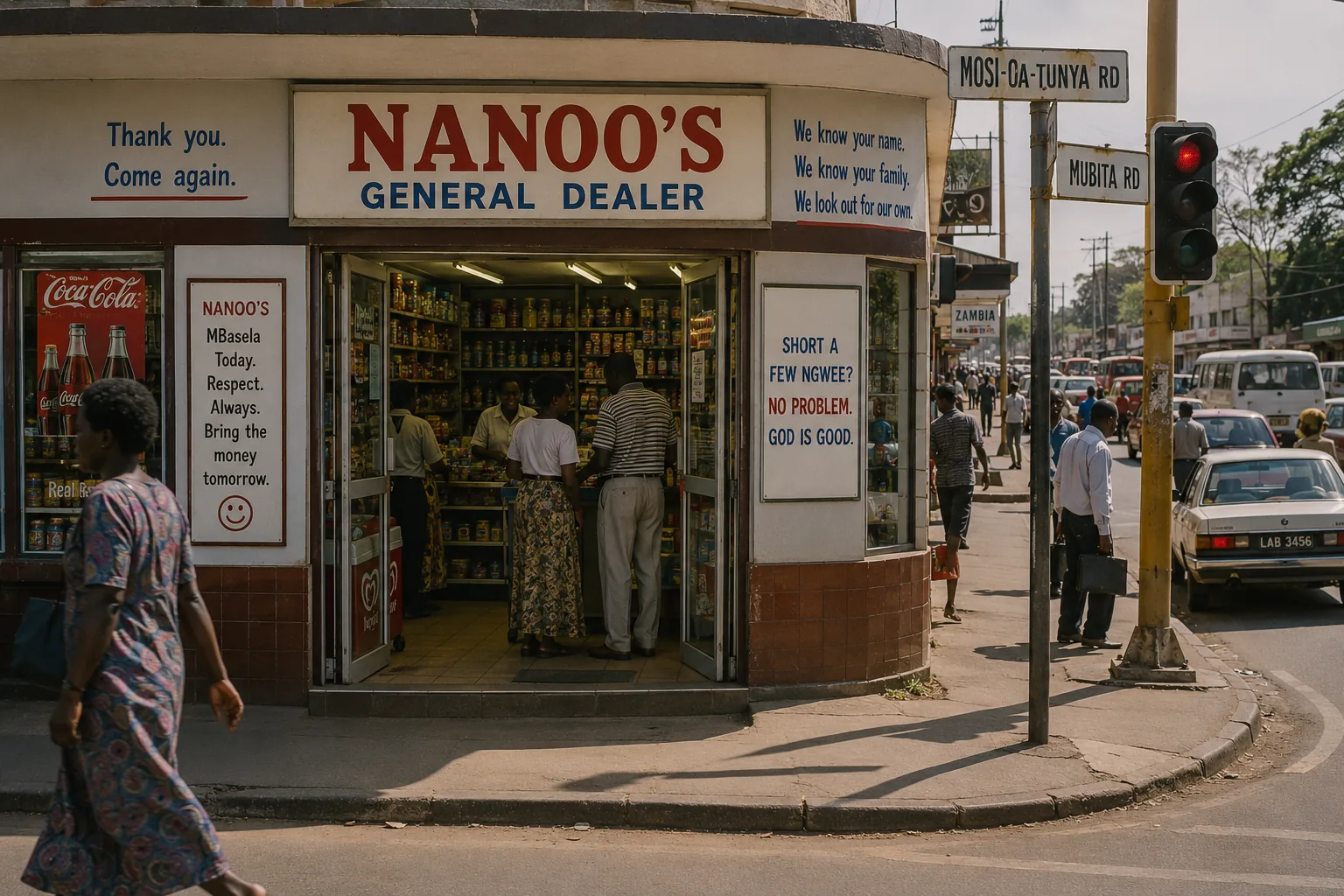
There was a shop on a corner in Livingstone called Nanoo's, and it raised half of us without ever meaning to.
It was not big. It did not need to be. It was the kind of corner store where the shelves knew you, where the floor had its own particular sound, where the whole neighbourhood ran its small daily errands and its small daily dramas. And behind the counter, every single day, stood Mr Nanoo; a generous Indian man with a soft voice and a sharp eye, who somehow knew every boy on that street by name, by family, and, inconveniently for some of us, by reputation.
Mr Nanoo gave mbasela before I understood it was strategy. You would come in for something small, and he would add a little extra; a sweet, a top-up, a rounding-down in your favour; just because. If you were short a few ngwee, he would wave it away and tell you to bring it next time, and somehow he remembered, and somehow you always did, because you could not bear to disappoint him. He gave advice nobody asked for, freely and constantly, to every young boy who passed through his door. And when he saw me starting to run with the wrong crowd, he did the thing only a man who actually cares would do; he told on me. To my people. Without apology.
I was furious at the time. Thirty years later, I understand it was love.
His shop never grew. He never opened a second branch. There was no Nanoo's Two, no franchise model, no expansion into the next town, no app, no loyalty card, no rebrand. And eventually, like so many corner shops, the doors closed for the last time and the corner became something else.
By every metric in every business textbook ever written, Mr Nanoo was not a success. No scale. No growth. No exit. A single small shop that opened, served, and shut.
And yet.
Thirty years later, I am writing about him. I can still see his counter. I can hear his voice. I remember his kindness with a precision I do not have for shops I walked into last month. I could not tell you the name of the well-lit supermarket that eventually took that corner, or a hundred better-funded businesses I have passed through since. But I remember Nanoo's. With love. Unprompted, unpaid, thirty years on.
Sit with how rare that is, because it is the rarest thing in all of business.
Companies spend fortunes; real fortunes; trying to buy exactly what Mr Nanoo built by accident. Every loyalty programme, every rebrand, every influencer deal, every "brand refresh" is a company reaching for the one thing that man had for free: a place in someone's memory that outlives the transaction, outlives the shop, and outlives thirty years. That thing has a name. We call it brand equity, and it is the most valuable and least buyable asset a business can own. Mr Nanoo, who as far as I know never read a single marketing book, was a branding genius.
So here is the question that makes this a strategy story and not just a sweet memory. Was Mr Nanoo a success, or a failure?
The honest answer, the one worth building a career on, is both. And the "both" is the entire lesson.
Mr Nanoo mastered the half of brand strategy that almost everyone gets wrong, and he was missing the half that almost everyone obsesses over. He had the promise, the feeling, the memory; the soul of a brand, kept so faithfully it outlived the building. What he did not have was the engine; the model, the system, the strategy that would have kept his doors open long enough for that generosity to compound instead of simply end. He had one wing. It was the harder wing to grow, and it still was not enough to fly on alone.
Because this is the truth a strategist has to be brave enough to say plainly: a brand without a business is a beautiful thing that dies young. And a business without a brand is a forgettable thing that dies unmourned. Mr Nanoo suffered the first. Most modern companies, drowning in growth and forgotten the week they close, suffer the second. Real brand strategy is the refusal to accept either one; it is building the machine that lets a Mr Nanoo keep his doors open, so the love never has to stop.
And notice what the brand actually was, because it was never the sign above the door. Mr Nanoo's brand was a promise, and he never once wrote it down. The promise was this: you are seen; you are looked after; you belong here. He kept that promise every day, to everyone, without variation, for years. That relentless consistency; the same promise, kept the same way, for every person, every time; is the whole game. A brand is not what you say about yourself. A brand is the promise people can count on you to keep, and the thing they remember you for long after you are gone.
The mbasela was not charity. It was the promise, made physical. It cost him almost nothing; a sweet, a few ngwee waved off; and it bought thirty years of unpaid memory in the mind of a boy who grew up to write about him. At OSC we teach three moves: identify the problem, provide the solution, add value. Mr Nanoo did all three on pure instinct, and the mbasela was the add value; the little extra that quietly turns a customer into a witness. Businesses now build whole departments trying to manufacture what a handful of sweets, given freely, did for that man.
So let me leave you where his story leaves me, with two questions, because a strategy without an honest question is just decoration.
First: if you closed your doors tomorrow, would anyone remember you in thirty years, with love, unprompted? If the answer is no, then all your growth is sandcastles; impressive, busy, and gone with the next tide. You have a business and no brand.
But second, and this is the one Mr Nanoo himself would want me to ask: if the answer is yes; if you are building something people would genuinely mourn; then you owe it to that love to build the strategy he never had. Do not let a beautiful promise die young for want of a model to carry it. Honour the Mr Nanoos of this world by refusing to choose between being loved and being here next year. Be both.
He never franchised. He never scaled. His doors have been closed for a long, long time.
And I still remember. Thirty years later, I still remember.
That, in the end, is the only thing a brand is really for.
Useful? Now score the brand behind the business.